Two Seasons, One Island: Zanzibar’s Clove Harvest Calendar and the People Who Climb For It
Published 26 September 2026 · Commodities.tz Editorial
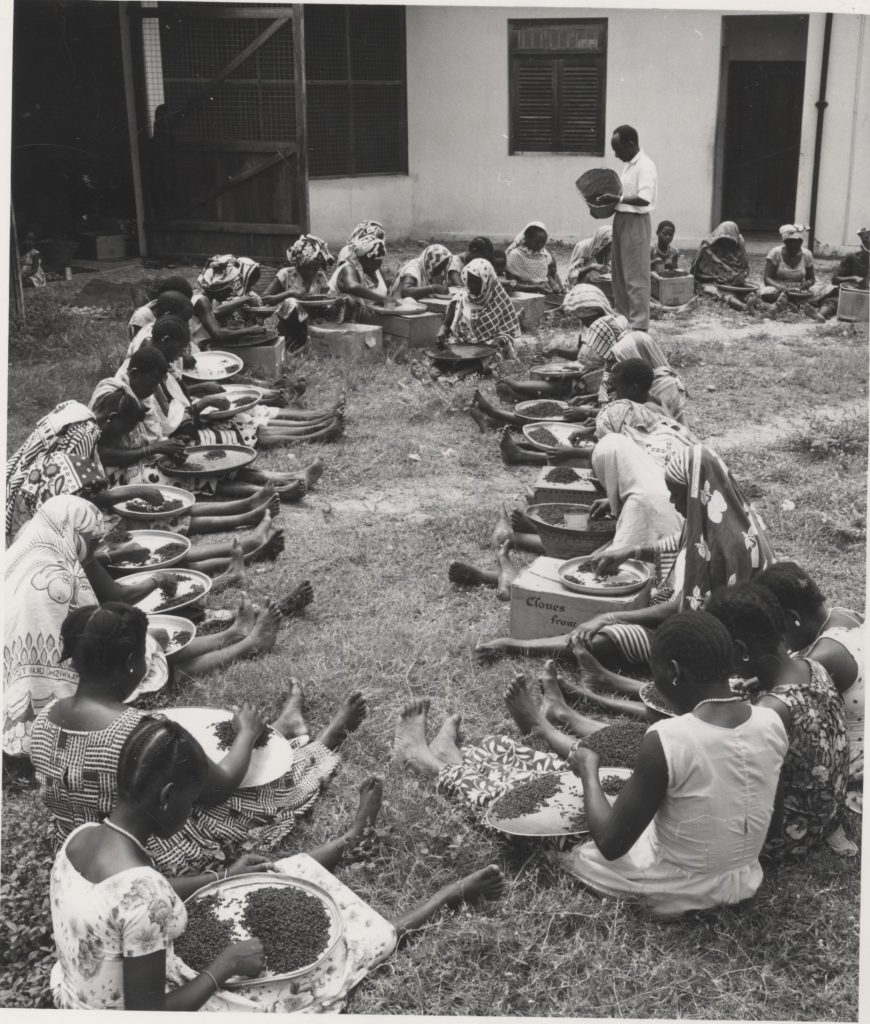
Zanzibar’s clove crop runs on two harvests a year, not one, and almost all of it is picked from trees that no machine has ever touched. The main season, known locally as Mwaka, runs roughly July through November, with picking concentrated in September and October; a second, lighter harvest called Vuli follows from December through March. Mwaka cloves tend to be heavier than the Vuli crop. Pemba island, rather than the more tourist-visited Unguja, does most of the actual growing — accounts of the harvest consistently describe farmers on Pemba working through the September–November window in numbers that dwarf clove activity on the main island.
Picking is vertical work
Clove trees grow tall — travel and agricultural writing on Pemba describes trees reaching ten to twelve metres, with some sources citing heights up to fifteen. The unopened flower buds that become cloves grow in dense clusters of 10 to 15 near the tips of branches, close to the canopy, which means picking is not a stoop-labor task like coffee cherry harvesting but a climbing one. Pickers go up barefoot for grip and snap off whole clusters by hand into woven baskets slung from the shoulder or waist. A skilled picker can gather five to eight kilograms of fresh buds in a day, according to on-the-ground accounts of the harvest published by the travel and culture outlet destination.com — a rate that reflects both the physical difficulty of the climb and the fact that buds have to be picked at a precise stage, before they open into flowers, or their value collapses.
This timing constraint is what actually drives the frantic pace of September and October on Pemba. Buds move from green and tightly closed to open and flowering within days, and only the closed bud has commercial value as a clove. A tree doesn’t ripen all at once either — pickers typically have to return to the same tree multiple times across a few weeks as different clusters mature, which is part of why the harvest requires sustained household and often hired labor rather than a single pass.
From basket to roadside mat
Once picked, the buds don’t go into a processing facility — they go onto woven mats, laid out along roadsides and in yards across the island. Traditional practice calls for three to five days of direct sun exposure, during which the buds visibly darken from green to the familiar reddish-brown of a finished clove. During September and October, these drying mats become one of the defining sights of Pemba: they line roads through village after village, and the smell of drying cloves is reported by visitors to be noticeable from the moment they step off the plane. It is also, unavoidably, weather-dependent labor — a rain shower during the drying window can force buds to be gathered up and re-spread once conditions improve, or can degrade the batch if the household can’t manage that in time.
A smaller, separate stream of the harvest goes to essential-oil production rather than the whole-bud spice trade. Leaves and stems that accumulate during picking and pruning are distilled locally, sometimes at genuinely small stills — a drum over a wood fire with copper tubing, as described in reporting on Pemba’s spice economy — producing clove oil that sells for around 30,000 Tanzanian shillings per litre in the local market.
A calendar with a long history behind it
The rhythm itself has been in place for close to two centuries. Cloves were introduced to Zanzibar in 1812, when the merchant Harmali bin Saleh brought seedlings from Réunion, and cultivation expanded dramatically after Sultan Said bin Sultan relocated his capital to Zanzibar in the 1830s and reportedly decreed that three clove trees be planted for every coconut palm — a policy meant to replace revenue lost to the ending of the slave trade with a new export commodity. By the end of the nineteenth century, Zanzibar was producing roughly ninety percent of the world’s cloves, and the September harvest that still empties Pemba’s villages into its tree canopies today is a direct descendant of that colonial-era planting push.
- destination.com, "Pemba's Clove Harvest: Scented Farm Stays on Zanzibar's Forgotten Island" — https://www.destination.com/guides/zanzibar-pemba-island-september-clove-harvest-season-shamba-farm-stays-octopus-foragers-empty-reefs-karkade-dusk — 2026-09-26
- AramcoWorld, "Spice Migrations: Cloves" (2021) — https://www.aramcoworld.com/articles/2021/spice-migrations-cloves — 2026-09-26
- Rove.me, "Spice Harvest and Tours Season in Zanzibar" — https://rove.me/to/zanzibar/spice-harvest — 2026-09-26