Tanzania Is a Washed-Coffee Country. A Small Experiment in the South Is Testing That.
Published 26 September 2026 · Commodities.tz Editorial
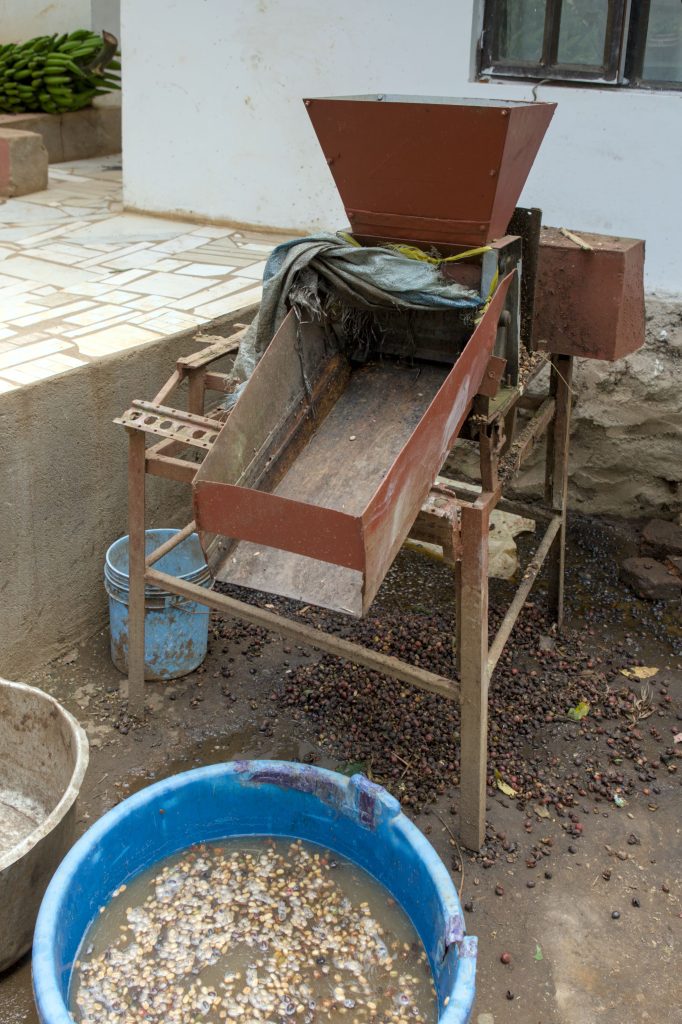
Processing method is the single biggest lever on cup profile after variety and terroir, and Tanzania has, for decades, pulled it almost entirely in one direction. An estimated 90% of the country’s arabica is fully washed, pulped at central pulping units (CPUs) run by farmer cooperatives rather than on individual farms. That is not an accident of taste — it is infrastructure and cooperative history showing up in the cup.
Why washed became the default
Washed processing requires water, pulping equipment and fermentation tanks that individual smallholders on half-hectare plots generally cannot afford or manage consistently on their own. Tanzania’s cooperative structure solved that problem by centralizing pulping: farmers deliver ripe cherry to a CPU, the cooperative pulps, ferments, washes and dries it under controlled conditions, and the resulting parchment is far more uniform than anything a few thousand individual farms could produce independently. This is also why Tanzania’s washed-arabica grading system (see our companion article on grading) is built around class numbers assessed after milling — cup consistency at that scale depends on centralized processing discipline, not on any one farmer’s technique.
The natural-processing experiment
Natural (dry) processing skips pulping entirely: whole cherries are dried intact, and the fruit sugars and mucilage stay in contact with the bean for the full drying period, producing heavier body and often fruit-forward, fermented or wine-like flavor notes. It is also riskier — uneven drying or excess moisture during a long dry-in-cherry period can produce moldy, over-fermented or “foxy” defects that ruin a lot.
In 2020, Sucafina Tanzania began working directly with cooperatives in the Southern Highlands to start and sustain production of specialty natural-processed arabica, reasoning that conditions for high-quality natural drying — extended dry-season windows, good airflow, elevated raised-bed sites — were favorable in parts of southern Tanzania in a way they are not in the wetter north. Parallel experiments with honey processing (where some mucilage is retained but the bean is still pulped) are underway in the same region, aimed at broadening Tanzania’s cup-profile range beyond its traditional black-currant-and-citrus washed character.
What it’s worth
The economic logic is straightforward even where hard per-kilo figures are not yet public: direct specialty buyers sourcing Tanzanian natural and honey lots have reportedly paid prices well above standard auction differentials for washed coffee of comparable grade, because a well-executed natural lot from a normally washed-only origin is a genuine rarity that lets roasters build a distinct story around it. That premium is the reward side of the trade-off; the risk side is that a poorly managed natural lot is worth less than a mediocre washed one, because the defects a bad natural process introduces (mold, ferment funk) are the kind specialty buyers reject outright rather than merely downgrade.
Why this stays a niche, not a shift
Natural processing in Tanzania remains a Southern Highlands cooperative initiative rather than a national trend, for reasons rooted in infrastructure as much as climate: the CPU network that makes washed coffee reliable at scale doesn’t translate to natural processing, which instead needs raised drying beds, consistent turning labor, and — critically — a dry season reliable enough to finish drying before rains or humidity introduce mold risk. Northern growing zones around Kilimanjaro and Arusha, where most of Tanzania’s coffee volume originates, don’t have the same favorable dry-season profile the south does, which is part of why the experiment started in the south and has stayed there. For buyers, the practical signal is this: a “Tanzania natural” offering is not yet a commodity category with an established price curve the way “Tanzania AA washed” is — it is still a cooperative-by-cooperative, harvest-by-harvest bet, and should be evaluated (and priced) as a specialty microlot rather than assumed to behave like the washed benchmark.
- A guide to Tanzanian coffee production — Perfect Daily Grind — https://perfectdailygrind.com/2021/10/a-guide-to-tanzanian-coffee-production/ — 2026-09-26
- Tanzania's Specialty Coffee regions: Secrets of its beans — XLIII Coffee — https://xliiicoffee.com/en/journal/tanzanias-specialty-coffee-regions/ — 2026-09-26
- Tanzania Coffee: Regions, Varieties, Harvest & Export Guide — Volcanica Coffee — https://volcanacoffee.com/origins/tanzania — 2026-09-26
- Exploring coffee grading systems: Tanzania — Perfect Daily Grind — https://perfectdailygrind.com/2022/10/exploring-coffee-grading-systems-tanzania/ — 2026-09-26