Two Crops, Two Trajectories: Arabica and Robusta Are Growing Apart in Tanzania
Published 26 September 2026 · Commodities.tz Editorial
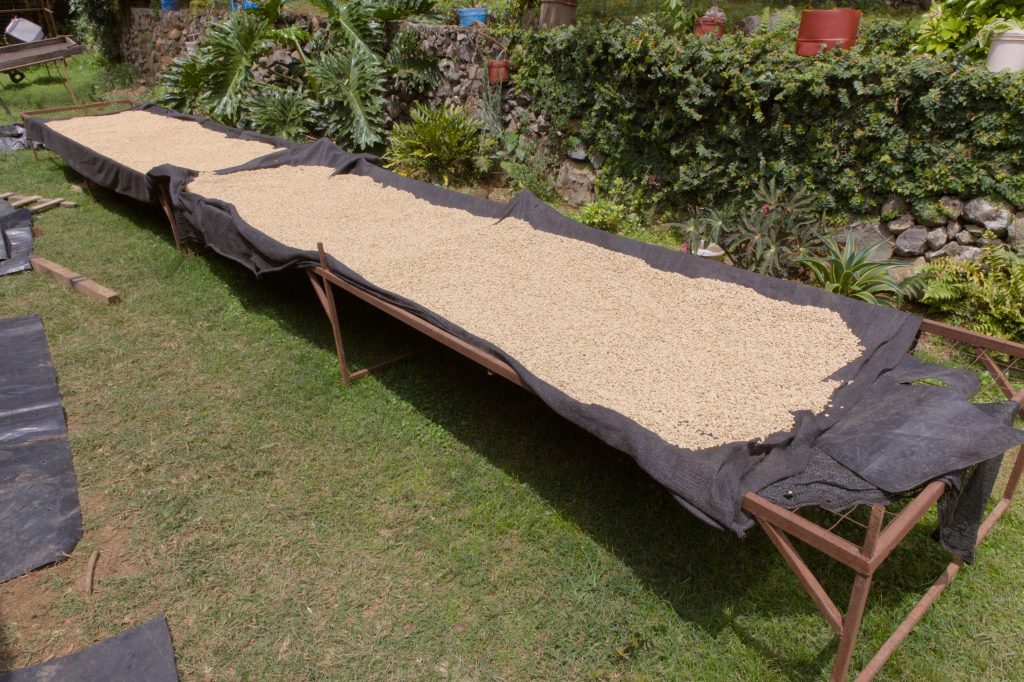
Tanzania is one of the few origins where arabica and robusta are both commercially significant, and current USDA forecasting shows the balance between them shifting in a specific, traceable direction: robusta is closing the gap, and one region is almost entirely responsible.
What the newest numbers say
According to the USDA Foreign Agricultural Service’s Coffee Annual report for Tanzania (TZ2026-0003, published 20 May 2026), the country’s 2026/27 marketing-year production is forecast at 1.6 million 60-kilogram bags — a 10.3% increase on the 1.45 million bags estimated for 2025/26. Of that 1.6 million bags, arabica accounts for roughly 850,000 bags and robusta for roughly 750,000 — a split of about 53% to 47%, far tighter than the historical rule-of-thumb figure of 60/40 or 70/30 arabica-weighted splits that older industry summaries still cite. Green bean exports are projected to rise to 1.41 million bags over the same period, with the European Union the largest buyer by volume and Japan the single largest destination by value, having spent $58.4 million on Tanzanian green coffee in 2024.
Why robusta is catching up
The growth is not evenly spread. USDA and industry reporting attribute the production increase substantially to coffee farms rehabilitated between 2019 and 2024 reaching full maturity, combined with improved rainfall and elevated commodity prices that have made replanting worthwhile for farmers. But the fastest expansion in planted area is specifically in robusta: Kagera and neighboring Kigoma, where subsidized seedling programs and — in the words of one recent trade report — “strong farm-gate pricing” are drawing more smallholders into robusta cultivation. Total harvested area nationally is forecast to grow from roughly 270,000 to 275,000 hectares, and Kagera/Kigoma robusta expansion is described as the leading driver of that increase.
Different crop, different growing system
The two crops don’t just occupy different regions — they sit on different production models. Robusta in Kagera grows at 800–900 meters along the shores of Lake Victoria, a lower and warmer band than arabica’s highland zones. Arabica is grown farther north on the slopes of Kilimanjaro and Meru and in the Southern Highlands around Mbeya, Mbinga and Ruvuma, almost always by smallholders on plots of half a hectare to a hectare, frequently intercropped with bananas. Nationally, an estimated 450,000 smallholder households produce around 90% of Tanzania’s coffee, with roughly 100–110 registered estates accounting for the balance — a structure that applies to both crops but plays out differently by region, since Kagera’s robusta economy is almost entirely smallholder-driven with comparatively little estate presence.
Why the split matters for buyers
Arabica and robusta are not substitutes for the same buyer. Tanzania’s washed arabica — the coffee that built the country’s reputation in specialty and washed-coffee markets in Japan, the EU and the US — competes on cup quality and grade (see our companion piece on Tanzania’s grading system). Robusta from Kagera competes on a different axis: bulk volume, blend and instant-coffee use, and price relative to other robusta origins such as Vietnam and Uganda. The national development strategy covering 2020–2025 set a target of lifting total production from 68,147 metric tons (2021 baseline) toward 300,000 metric tons, while separately trying to raise the specialty share of arabica output from 37% to 70% — two goals that pull the sector in different directions, since scaling robusta volume in Kagera does little to move the specialty-arabica target, and vice versa. For buyers and analysts tracking Tanzania, the practical takeaway is that “Tanzania coffee production” is no longer a single story: it is an arabica story centered on quality and specialty market share, and a robusta story centered on smallholder expansion in one specific region.
- Tanzania Coffee Production to Rise 10 Percent in 2026/27 — Qahwa World (citing USDA FAS Coffee Annual TZ2026-0003) — https://backend.qahwaworld.com/tanzania-coffee-production-2026/ — 2026-09-26
- Tanzania Coffee Export Review — Royal Coffee — https://royalcoffee.com/tanzania-export-review/ — 2026-09-26
- Tanzania Coffee Report: Production Rising as Old Farms Get New Life — Daily Coffee News — https://dailycoffeenews.com/2024/07/01/tanzania-coffee-report-production-rising-as-old-farms-get-new-life/ — 2026-09-26
- Tanzania Coffee Industry Development Strategy 2020–2025 — Café Africa (hosted PDF) — https://www.cafeafrica.org/wp-content/uploads/2024/03/Tanzania-Coffee-Industry-Development-Strategy-2020-%E2%80%93-2025.pdf — 2026-09-26