Screen Size Isn’t Cup Quality: How Tanzania Actually Grades Green Coffee
Published 26 September 2026 · Commodities.tz Editorial
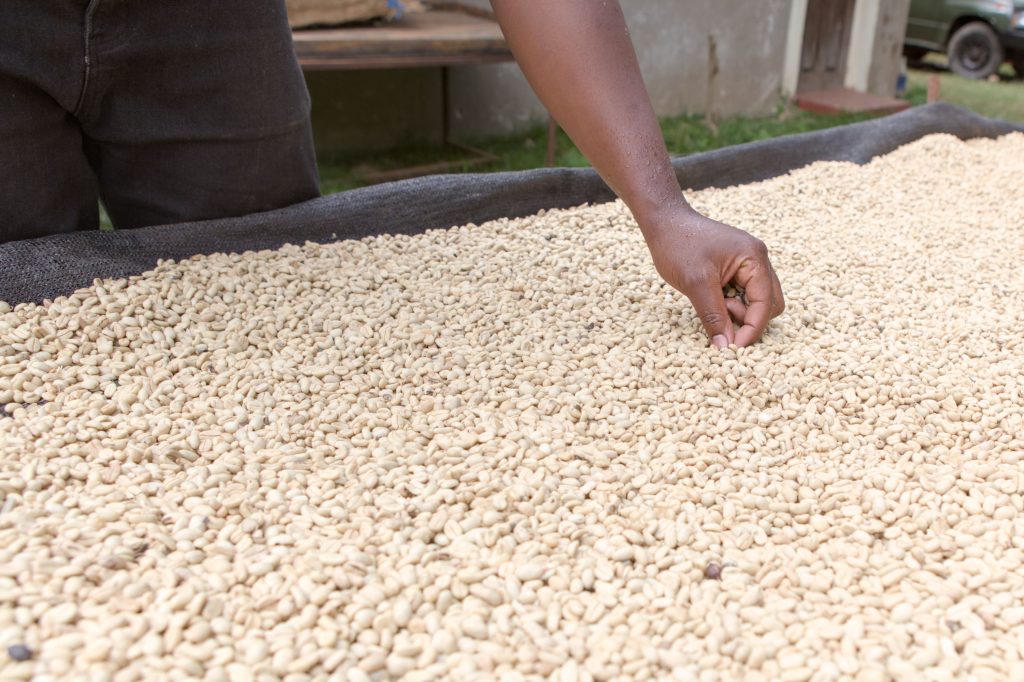
A Tanzanian offer sheet listing “AA” or “PB” is not telling a buyer how the coffee tastes. It is describing how large the bean is and how dense it is — a physical sorting system, not a cupping score. Tanzania inherited this approach from British colonial-era grading conventions, and it still governs how coffee moves through the Moshi Coffee Exchange today.
Two grading tracks, not one
Tanzania actually runs two separate classification systems depending on how the coffee was processed, and conflating them is the most common mistake outside buyers make.
Naturally processed (“hard”) arabica
Hard arabica — coffee dried in the cherry rather than washed — is sorted purely by screen size and density into eleven official grades: AAA, AA, A, B, PB, C, E, F, AF, TT and UG, plus TEX. AA is the largest-screen grade (screens 17–18); AB is a blend of A-grade beans (sorted on a 6.8mm screen) and B-grade beans (6.2mm), mixed together; PB is peaberry, a natural mutation in which a cherry produces one round bean instead of two flat ones. Peaberry occurs in roughly 5% of any coffee crop globally, and Tanzania’s is unusually prized — it is a significant part of why Tanzanian coffee holds a distinct position in the U.S. specialty peaberry market.
Washed (“mild”) arabica
Washed coffee — some 90% of Tanzania’s arabica crop, processed through cooperative-run central pulping units — goes through a different and more granular system. Parchment is first split into three groups (P1, P2, P3), then classed on a 17-point scale that scores size, density, cup quality, defect count and roasted appearance together. Classes 1 to 3 correspond to fine-to-good cup quality; classes 4 to 6 sit in the fair-average-quality (FAQ) range. Trade reporting on the system suggests a large share of Tanzania’s washed crop lands in the lower classes rather than the top tier — consistent with Tanzania’s own coffee strategy, which put specialty-grade output at only 37% of national production as its 2020 baseline.
Robusta, sorted differently again
Robusta, grown almost exclusively in Kagera, uses its own screen-based scale: Screen 18 (“Extra”) is the top tier and can score well on Specialty Coffee Association cupping protocols despite being robusta; Screen 16 (“Superior”) is clean and largely defect-free; anything below Screen 12 (“Triage”) is small, broken, and liable to carry foreign matter.
The quality “baskets” buyers should ask about
Underneath the size grades, Tanzanian trade also groups coffee into rougher quality baskets: “Grinders” for lower-quality lots destined for blends, “FAQ” for cleaner, more uniform coffee typically coming out of the northern growing zones, and “AMEX” — largely home-processed lots from the Southern Highlands, where farm-level processing is more common than centralized wet milling. A lot’s basket matters as much as its letter grade for anyone actually cupping before they buy.
Where the grading actually happens
The Tanzania Coffee Board (TCB), reinstated after the sector’s early-1990s liberalization, is the body responsible both for grading and for running the Moshi Coffee Exchange, the weekly auction where licensed exporters bid on lots by grade and region. Auction records are specific down to the lot: a Board auction held on 23 October 2025, for instance, listed a Mbinga-origin lot of 1,301 bags weighing 78,077 kilograms moving through that week’s sale — the kind of granularity buyers can check directly against Board publications rather than relying on generic origin marketing. Top-grade growers with the right registration can bypass the auction entirely and export directly, which is a separate track from the grading system itself.
What this means for buyers
Screen size correlates with visual uniformity and roast evenness, which is why AA and Screen 18 command a premium in markets that prize large, consistent beans. But it does not substitute for cupping. A buyer sourcing for a specialty program should ask for the class number (1–17) on washed lots and the quality basket (Grinders/FAQ/AMEX) alongside the letter grade — the letter grade alone tells you almost nothing about whether the coffee in the bag will cup as advertised.
- Exploring coffee grading systems: Tanzania — Perfect Daily Grind — https://perfectdailygrind.com/2022/10/exploring-coffee-grading-systems-tanzania/ — 2026-09-26
- Coffee production in Tanzania — Wikipedia — https://en.wikipedia.org/wiki/Coffee_production_in_Tanzania — 2026-09-26
- Tanzania Coffee Board Auction M11/H2 Moshi record — coffee.go.tz — https://www.coffee.go.tz/uploads/documents/sw-1712208012-TCB%20-%20M1%20-%20H2%20MOSHI.pdf — 2026-09-26
- Tanzania Coffee Export Review — Royal Coffee — https://royalcoffee.com/tanzania-export-review/ — 2026-09-26
- Tanzania Coffee Industry Development Strategy 2020–2025 — Café Africa (hosted PDF) — https://www.cafeafrica.org/wp-content/uploads/2024/03/Tanzania-Coffee-Industry-Development-Strategy-2020-%E2%80%93-2025.pdf — 2026-09-26