The Fermentation Gap: Why the Same Tanzanian Cocoa Crop Sells at Three Different Prices
Published 25 September 2026 · Commodities.tz Editorial
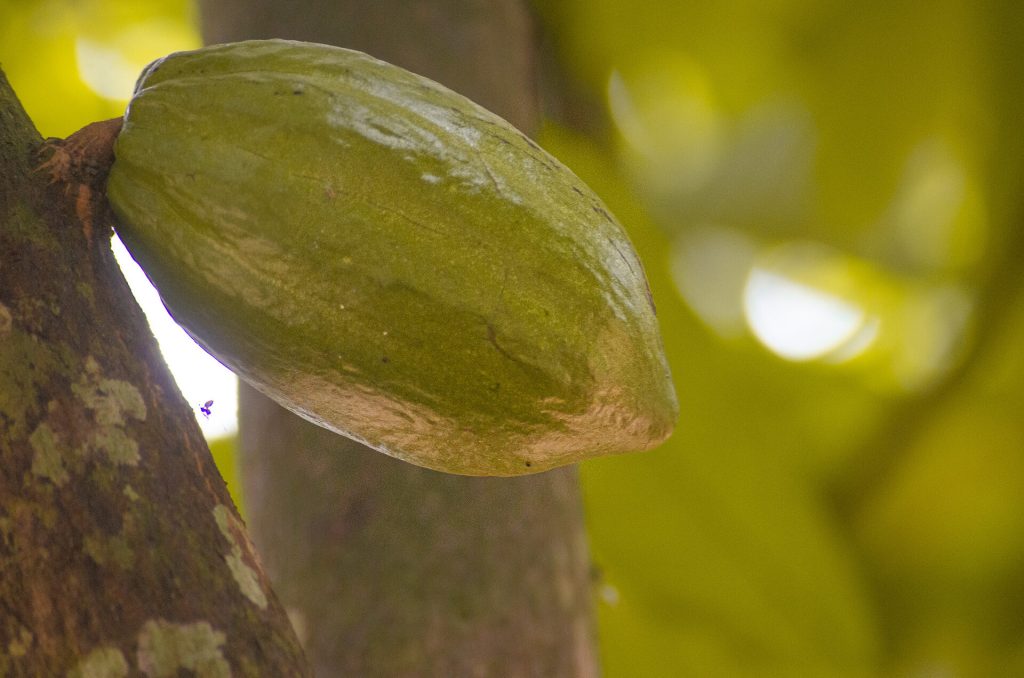
Tanzania is not a cocoa country in any way that shows up on a world map of the crop. In 2024 it produced roughly 15,000 tonnes of cocoa beans, good for about 23rd place globally and roughly 0.3% of world output, according to FAOSTAT-derived figures compiled by Wikipedia's country-production rankings. Côte d'Ivoire alone produced 1,890,442 tonnes that year — 126 times Tanzania's entire crop — and together with Ghana's 530,000 tonnes, the two West African neighbors account for roughly 65% of everything the world's chocolate industry grinds. Against that backdrop, Tanzania barely registers as a supplier of volume.
What makes Tanzania worth a closer look isn't scale. It's that inside this small crop, two parallel markets have formed for beans grown by broadly similar smallholders on broadly similar land — and they pay wildly different prices for what is, genetically, close to the same cocoa. The dividing line isn't origin. It's what happens to the bean in the first five to seven days after it's cut from the pod.
Where the crop actually comes from
Contrary to the impression left by Zanzibar's spice-tour circuit, the island's cacao is a colonial-era relic, not a commercial crop. Zanzibar carried genuine Criollo-descended plantings, introduced via a Mexico-Philippines-Pacific trade route under earlier Arab and European rule, but that planted area collapsed after the 1964 revolution and the nationalization that followed. What tourists see on spice-farm visits today are legacy and demonstration trees, not an export supply chain.
The real production base sits on the mainland, in Kyela and Rungwe districts of Mbeya region, near Lake Nyasa in Tanzania's far southwest — together accounting for more than 95% of the country's national cocoa output. A second, smaller belt has developed in the Kilombero Valley to the northeast, where a specialty-focused buying operation has built its business (more on that below). Reports of cocoa in Kigoma, near Lake Tanganyika, are best treated as speculative: agricultural-development commentary has flagged Kigoma, Katavi and Mpanda as climatically suited to cocoa, but no exporters or buyers currently operate there and there is no verified commercial output — Kigoma cocoa is, at this point, a possibility, not a belt.
Tanzania's cocoa lineage traces to German and British colonial introductions. Germans planted a 300-acre estate in the Usumbara Mountains in the late 19th century using seedlings likely sourced from Cameroon's Amazon-heritage stock; the British later brought in hybrids via Uganda descended from Trinidad harvests collected in 1880-81, carrying Criollo and Amazonian genetics. That shared ancestry matters for the argument that follows: farmers in Kyela, Rungwe and Kilombero are mostly not growing dramatically different plant material from one another. The gap that opens up downstream is man-made.
Two prices, one country
Kyela Cooperative Union (KYECU), the primary marketing body for the Mbeya belt, moves cocoa through Tanzania's Warehouse Receipt System, now integrated with the Tanzania Mercantile Exchange (TMX). For the 2025/26 season, KYECU set a reference price of TZS 10,000 per kilogram against an expected harvest of nine million kilograms — a projected TZS 90 billion in farmer income, as union leadership described to local press. Tanzania's Ministry of Agriculture weekly market bulletin for early May 2026 recorded actual trading in a considerably wider band, TZS 5,540 to 16,340 per kilogram, averaging TZS 10,929 across 7.36 million kilograms sold — a market working roughly as commodity markets do, with grade, timing and buyer competition producing a spread around a reference point. At a 2026 average exchange rate near TZS 2,560 to the US dollar, that average works out to a little over $4 per kilogram — squarely in line with what bulk, undifferentiated cocoa fetches internationally.
Roughly 250 kilometers northeast, in the Kilombero Valley village of Mbingu, a social enterprise called Kokoa Kamili has been running a different experiment since 2014. Founded by Brian LoBue and Simran Bindra, it buys cacao while still wet and unfermented, straight off the farm, and ferments it centrally in three-tiered wooden boxes before drying it on raised mesh beds. That single change — moving fermentation off roughly 3,000 individual smallholdings, each with its own inconsistent timing and technique, and into one controlled facility — is enough to convert the same regional planting stock into a bean that craft chocolate makers buy by name. Dick Taylor Craft Chocolate's sourcing page for its Tanzania bar states a 2025 buying price of $15.50 per kilogram, a 76% premium over commodity cocoa, with a farmgate price to growers of $12.89 per kilogram — three to four times what the Mbeya cooperative-marketed average returned in the same window.
There's a regulatory footnote that explains why this model hasn't simply spread everywhere: selling wet, unfermented beans off-farm was historically prohibited under Tanzanian rules aimed at preventing exactly the kind of uneven, low-quality fermentation smallholders tend to produce on their own. Kokoa Kamili's centralized-fermentation model only became legally workable after it persuaded local authorities to waive that restriction — a sign that the quality gain from centralizing post-harvest processing was worth rewriting the rule, but also that doing so required a specific institutional push, not just farmer willingness.
The premium is buyable, not just grown
Tanzania's own government-adjacent development work backs up the pattern. TechnoServe, funded by Irish Aid, ran a program that trained more than 13,000 Tanzanian cocoa farmers and organized 66 farmer business groups around improved post-harvest handling — without necessarily building Kokoa Kamili-style centralized fermenteries. The result: production gains of more than 50% in participating groups and price premiums exceeding 20% above prevailing market rates. That's a smaller jump than Kokoa Kamili's multiple, but it confirms the direction: in Tanzanian cocoa, changing what happens after harvest — not what's planted, and not where — is the lever that actually moves price.
KYECU appears to be reading the same signal. Beyond its TMX integration, the union has launched a farmer-funded processing plant initiative, financed by a levy of TZS 50 per kilogram sold, which had raised more than TZS 500 million in its pilot phase, and management has told local press it expects in-house processing capacity within two years. That's the cooperative-scale version of the same bet Kokoa Kamili made at enterprise scale: that Tanzania's path to better returns runs through capturing more of the post-harvest value chain domestically, rather than exporting undifferentiated beans and competing on volume it will never have against Côte d'Ivoire and Ghana.
For buyers and researchers tracking Tanzanian cocoa, the practical implication is that origin alone tells you little. A bag labeled "Tanzania" could be Mbeya cooperative cocoa trading near the commodity floor, or Kilombero Valley cocoa fermented under contract for a craft chocolate maker at three to four times that price. The difference sits in the first week after harvest, not in the soil.
- Tanzania | the C-spot — https://c-spot.com/atlas/chocolate-sources/africa/tanzania/
- List of countries by cocoa production — Wikipedia (FAOSTAT-sourced) — https://en.wikipedia.org/wiki/List_of_countries_by_cocoa_production
- Reviving Cocoa in Tanzania — TechnoServe — https://www.technoserve.org/our-work/projects/reviving-cocoa-in-tanzania/
- Kyela eyes Sh100bn from four crops as farmers assured of market, prices — TNC — https://tnc.tz/2026/01/15/kyela-eyes-sh100bn-from-four-crops-as-farmers-assured-of-market-prices/
- Kokoa Kamili, Tanzania 70% 2025 Harvest Single-Origin Chocolate Bar — Dandelion Chocolate — https://www.dandelionchocolate.com/products/kokoa-kamili-tanzania-70-chocolate-bar
- Tanzania Sourcing — Dick Taylor Craft Chocolate — https://dicktaylorchocolate.com/pages/tanzania-sourcing
- Weekly Market Bulletin 04-08 May 2026 — Tanzania Ministry of Agriculture (MASOKO) — https://www.kilimo.go.tz/uploads/documents/en-1778314460-Weekly%20Market%20Bulletin%2004%20-%2008%20May,%202026.pdf
- Kyela cocoa boom: Farmers urged to go commercial as prices rise — The Citizen — https://www.thecitizen.co.tz/tanzania/business/kyela-cocoa-boom-farmers-urged-to-go-commercial-as-prices-rise-4471128
- Tanzanian Shilling projected to rally to 2,560 against US dollar in 2026 — Streamlinefeed — https://streamlinefeed.co.ke/news/tanzanian-shilling-projected-to-rally-to-2560-against-us-dollar-in-2026