Why Zanzibar and Mainland Tanzania Run Two Completely Different Commodity Trading Systems
Published 28 September 2026 · Commodities.tz Editorial
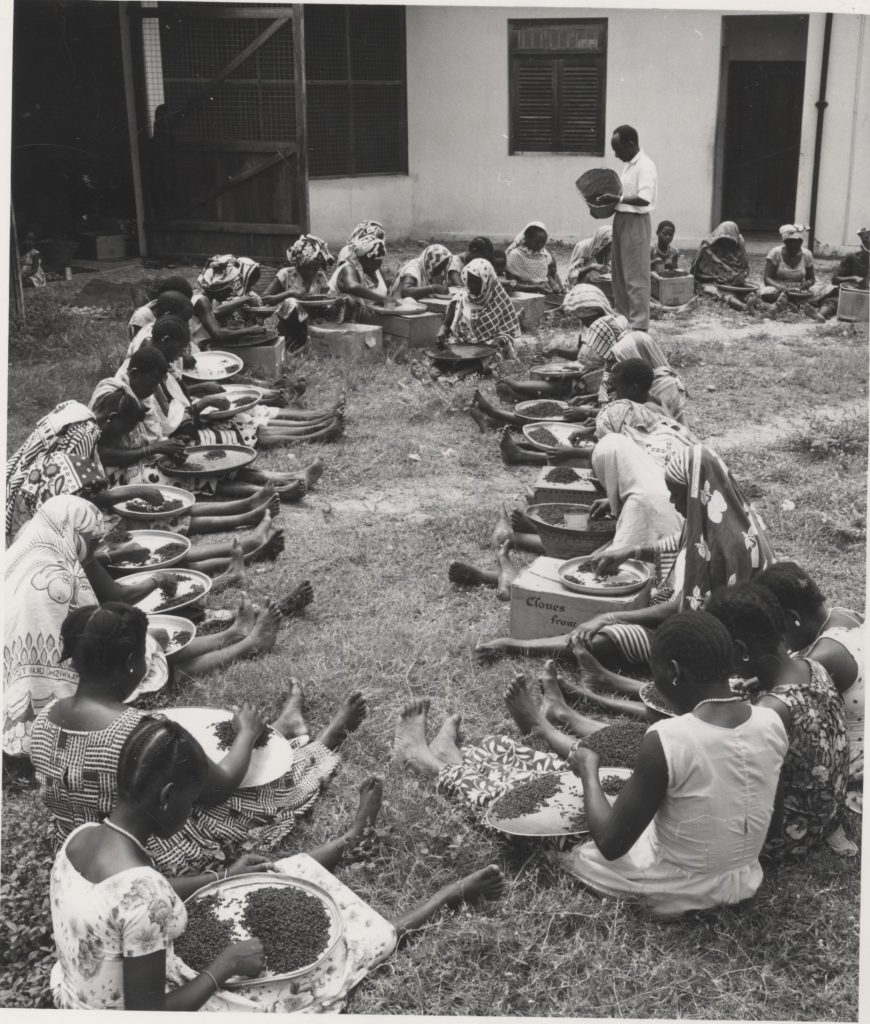
Zanzibar buys and exports cloves through a single state corporation that has held the exclusive legal right to do so for roughly sixty years. Three hundred kilometers away on the mainland, a farmer growing coffee, cashew, cocoa, or sesame sells into a system built from cooperatives, licensed private buyers, and a commodity exchange running competitive auctions. Both are part of the same country. Both trace back to the same kind of post-independence state monopoly. Only one of them kept it.
That’s the real question underneath Zanzibar’s clove trade, and it isn’t really about spices. It’s about why the United Republic of Tanzania ended up running two different commodity-marketing systems under one flag — and why that arrangement is not an accident but a direct consequence of what the 1964 Union did, and did not, merge.
What actually merged in 1964 — and what didn’t
Tanganyika and Zanzibar became one country on 26 April 1964, a few months after the Zanzibar Revolution deposed the Sultanate. The Articles of Union that created the merger did not fuse the two governments into one administration. Instead they listed a specific, finite set of “Union matters” reserved to the new central government — originally eleven, since expanded to 22 as of recent counts — covering things like the constitution, defense, foreign affairs, citizenship and immigration, currency, and, notably, external trade and borrowing, along with income tax, customs, and excise duties.
Everything not on that list stayed with the two sides separately. Domestic commerce — how a crop gets bought, priced, licensed, and moved from farm to warehouse before it becomes an export shipment — was never placed on the Union list. Zanzibar kept its own government, its own House of Representatives, and full authority to organize its own domestic marketing institutions however it saw fit, subject only to the Union government’s control over the external trade transaction itself and the tax regime layered on top of it. This is a matter of public constitutional record, not inference: it’s written into the Articles of Union and repeatedly cited in Tanzanian legal and political commentary on Union tensions.
That single design choice — commerce as a non-Union matter — is the hinge this whole story turns on. It means that when the mainland eventually reformed its crop-marketing institutions, Zanzibar was under no obligation to follow, and didn’t.
Two monopolies, born from the same era
Here is the part that gets flattened in most accounts: Zanzibar’s clove monopoly was not always structurally unique within the country. It was, at founding, the same kind of institution the mainland was building at the same time.
After the 1964 Revolution, the Revolutionary Government of Zanzibar (RGZ) under Abeid Karume nationalized all clove and coconut plantations and the banks along with them — a documented act of the revolutionary period, not a later policy drift. Out of that nationalization came the Zanzibar State Trading Corporation (ZSTC), set up as the sole legal buyer and exporter of cloves from the isles. Public sources disagree on the precise year — ZSTC’s own materials point to 1966, while at least one Tanzanian academic account dates it to 1968 — but both accounts agree it was a direct creature of the post-revolution nationalization drive, not an older colonial holdover repurposed.
On the mainland, the same era produced the same kind of institution for different crops. Coffee marketing, historically run through cooperative unions going back to the Kilimanjaro Native Planters’ Association in the 1920s, was nationalized in 1976-77: the cooperative unions were dissolved and a central government marketing authority took over buying, grading, and exporting coffee outright — structurally similar to what ZSTC still does with cloves today. Cashew followed a parallel track, formalized as the Cashewnut Board of Tanzania under Act No. 21 of 1984, again as a state body with buying and licensing authority over the crop.
Through the mid-1980s, in other words, Zanzibar and the mainland were not running “different systems.” They were running the same kind of system — state monopoly marketing boards — for their respective flagship crops. The divergence came later, and it came from opposite directions.
Where they split: structural adjustment hit one side, not the other
Starting in the mid-1980s, Tanzania undertook IMF- and World Bank-backed Structural Adjustment Programmes, and agricultural marketing was a central target. Coffee was formally liberalized in 1993: the state marketing board’s exclusive buying role was stripped out, cooperative unions were allowed to compete again, and private brokers and exporters were licensed to buy coffee directly from farmers, bypassing the Moshi auction system that had underpinned price discovery. Cashew followed a similar path — producer prices rose after the mid-1990s liberalization, and licensed private buyers entered a market the Cashewnut Board had previously monopolized.
What replaced the mainland’s old monopolies was not, however, a fully deregulated free market. It became something more specific: a regulated multi-buyer system. Crop boards (the Tanzania Coffee Board, the Cashewnut Board of Tanzania) still license who may buy and export, and still run or oversee the marketplace mechanics — but they stopped being the buyer themselves. From 2007, a Warehouse Receipt System required cashew to be aggregated through farmer cooperative societies (AMCOS) and sold via public auction at licensed warehouses rather than sold to whichever private trader showed up at the farm gate. Coffee, cashew, cocoa, sesame, and several other crops now clear largely through the Tanzania Mercantile Exchange (TMX, trading since 2018), which runs the auctions that connect AMCOS-aggregated farmer lots to competing licensed buyers, under a separate Warehouse Receipt Regulatory Board.
Crucially, this mainland model has not been a stable, one-way liberalization either. Coffee’s private-buyer system frayed badly enough by the mid-1990s — brokers buying up smallholder coffee ahead of auction and destroying its price-discovery function — that in January 2018 the government reversed course again: it revoked direct-purchase licenses, made cooperative membership mandatory for smallholders, and forced all coffee back through the Moshi auction. The mainland’s institutional history since the 1970s is a pendulum: monopoly board, then liberalization, then partial re-regulation into cooperative-anchored auctions — not a straight line toward either extreme.
Zanzibar’s clove sector took none of these turns. ZSTC’s exclusive buyer-and-exporter role was never dismantled during the structural-adjustment years; it was instead re-legislated and reaffirmed under Zanzibar’s own law — the Zanzibar State Trading Corporation Act No. 11 of 2011 and the Clove Development Act No. 2 of 2014 — with a still-active 1985 clove market law barring farmers from selling directly to private buyers or exporters. There was no external pressure that forced the change on the mainland side to also apply to Zanzibar, because — per the Articles of Union — there was never a single national commodity-marketing policy to begin with. Whether RGZ actively considered and rejected liberalization, or simply never faced the same donor-conditionality pressure that hit the mainland’s IMF programs, is not something the public record we reviewed settles; that gap is worth flagging rather than papering over.
It isn’t only cloves — Zanzibar runs parallel economic institutions generally
The clove system is the most visible example of Zanzibar’s separate institutional track, but it isn’t the only one, and treating it as an isolated quirk of one crop understates the pattern.
Tax administration splits the same way commerce does. The Tanzania Revenue Authority (TRA) — a Union body — still collects customs, excise, and income tax even within Zanzibar, because those are Union matters under the Articles. But the Zanzibar Revenue Authority (ZRA, evolved from the earlier Zanzibar Revenue Board) separately administers all of Zanzibar’s domestic, non-Union taxes. It’s a twin-bureaucracy structure, not unified collection under one national tax authority — even though from outside the country it looks like “Tanzania” has one tax system.
Investment promotion shows the same pattern. Zanzibar has run its own investment authority since 1986, when it existed as a department under the Ministry of Finance; it became a semi-autonomous agency in 1992, and a parallel Zanzibar Free Economic Zones Authority (ZAFREZA) was created the same year to run special economic zones. The two were merged into the current Zanzibar Investment Promotion Authority (ZIPA) under a 2004 law. None of this runs through the mainland’s Tanzania Investment Centre; Zanzibar administers its own investor-facing institutions end to end, including the special economic zones now marketed to manufacturers and agribusiness investors.
The throughline across tax, investment promotion, and crop marketing is the same: Zanzibar is not a Tanzanian region that happens to have an unusual clove policy. It is a semi-autonomous government that built (and, in the case of cloves, kept) its own parallel economic institutions in every domain the Union structure left open to it — because the Union structure left commerce open to it from day one.
What this means, and what it doesn’t
None of this is an argument that ZSTC’s model is failing farmers less, or more, than the mainland’s auction system — that’s a pricing and welfare question, and it’s the one spices.tz’s other coverage on clove pricing and the ZSTC system addresses directly; it isn’t recycled here. The structural point is narrower and, we think, underreported: Tanzania’s “commodity trade rules” are not one national system with a Zanzibar exception. They are two separate systems that happened to start from the same institutional template in the 1960s-80s and were then pulled apart by a reform wave that only had jurisdiction over one of them.
For anyone doing business across this network — a trader sourcing cloves versus one sourcing cashew, a company deciding where to register an export license, an investor comparing Zanzibar’s ZIPA-administered zones to mainland incentive regimes — the practical upshot is that “Tanzania” is the wrong unit of analysis for commodity-trade rules. The right unit is which side of the Union you’re actually transacting in, and which of the two institutional lineages — monopoly board or cooperative-anchored auction — governs the crop you’re trying to move.
- Government of the United Republic of Tanzania — The Articles of Union Between Tanganyika and Zanzibar — https://www.vpo.go.tz/uploads/publications/sw-1593598783-ARTICLES%20OF%20UNION%20final.pdf — accessed 2026-09-28
- The Conversation — "Tanganyika and Zanzibar: Tanzania's 60-year-old union may need a restructure" — https://theconversation.com/tanganyika-and-zanzibar-tanzanias-60-year-old-union-may-need-a-restructure-229933 — accessed 2026-09-28
- Zanzibar Investment Promotion Authority — "History" — https://www.zipa.go.tz/history/ — accessed 2026-09-28
- Zanzibar Revenue Authority — official site — https://www.zanrevenue.org/ — accessed 2026-09-28
- Wikipedia — "Coffee production in Tanzania" — https://en.wikipedia.org/wiki/Coffee_production_in_Tanzania — accessed 2026-09-28
- Daily Coffee News — "Tanzania Coffee Farmers and Traders Face Stark New Regulatory Reality" — https://dailycoffeenews.com/2018/05/14/tanzania-coffee-farmers-and-traders-face-stark-new-regulatory-reality/ — accessed 2026-09-28
- Laws of Tanzania — Cashewnut Board of Tanzania Act (Act No. 21 of 1984) — https://tanzanialaws.com/statutes/principal-legislation/44-cashewnut-board-of-tanzania-act — accessed 2026-09-28
- WIPO Lex — "The Union of Tanganyika and Zanzibar Act, 1964 (Act No. 22 of 1964)" — https://www.wipo.int/wipolex/en/legislation/details/11127 — accessed 2026-09-28