One Word, Five Rulers: What “Tanzanian Quality” Actually Means Across Cashews, Coffee, Honey and Cloves
Published 28 September 2026 · Commodities.tz Editorial
The word “quality” is doing four different jobs, and buyers keep treating it as one
International buyers routinely ask suppliers for “good quality Tanzanian cashews” or “high-quality Tanzanian honey” as if quality were a single dial that runs from low to high, the same way it works for, say, steel or diesel. It isn’t. Pull apart how Tanzania’s own export sectors actually define and measure quality for four major commodities, and you find four unrelated measurement systems — a kernel-size code, a bean-density-and-screen code, a moisture-and-enzyme threshold, and a visual-and-moisture price tier — none of which converts into any of the others, and none of which, on its own, tells a buyer whether the product in a specific bag or drum will perform as expected.
This isn’t a criticism of Tanzanian exporters. It’s a structural fact about commodity grading everywhere, and it becomes a costly blind spot the moment a buyer assumes a grade code is a quality score.
Cashews: a size code, not a taste or freshness score
Tanzania’s cashew trade runs on two separate metrics that buyers often collapse into one. The first, used at the raw-nut auction stage, is the outturn ratio — recoverable kernel pounds per 80kg bag of raw nuts, with roughly 48 lbs treated as standard. The second, applied only after the nut has been shelled and peeled, is kernel grading under the UNECE’s international commercial-quality standard for cashew kernels (Standard DDP-17, adopted November 2012). As cashews.tz’s grading explainer lays out, the W-codes — W180, W210, W240, W320, W450, W500 — are pure size counts: a W320 kernel lot contains no more than 320 whole kernels per pound (about 706 per kilogram). Smaller numbers mean bigger nuts. That’s it. Size says nothing about how fresh the nut is, how it will taste, or how it was stored.
Separately, kernels are sorted into three color/blemish classes — Extra (“white”), Class I (“scorched”), Class II (“dessert”) — with defect tolerances of 6%, 9%, and 12% respectively, and a moisture ceiling of 5.0% across all three. A buyer who only asks for “W320, top quality” without specifying the class and the moisture reading on the certificate of analysis is leaving two of the three real quality variables unspecified.
There’s a sharper wrinkle here that has nothing to do with the kernel itself: under current international rules, the country where shelling and peeling happens — not where the cashew tree grew — can legally be declared as the kernel’s country of origin. A raw Tanzanian nut processed in Vietnam or India is marketed as Vietnamese- or Indian-origin cashew. This is arguably one reason “Tanzanian cashew” is comparatively invisible on retail shelves worldwide despite Tanzania being a significant African producer — the quality question a buyer should be asking isn’t just “what grade” but “where was this actually processed, and does the label reflect that.” (Full breakdown: cashews.tz, “What ‘W320’ Actually Means”.)
Coffee: the letter grade describes the bean, not the cup
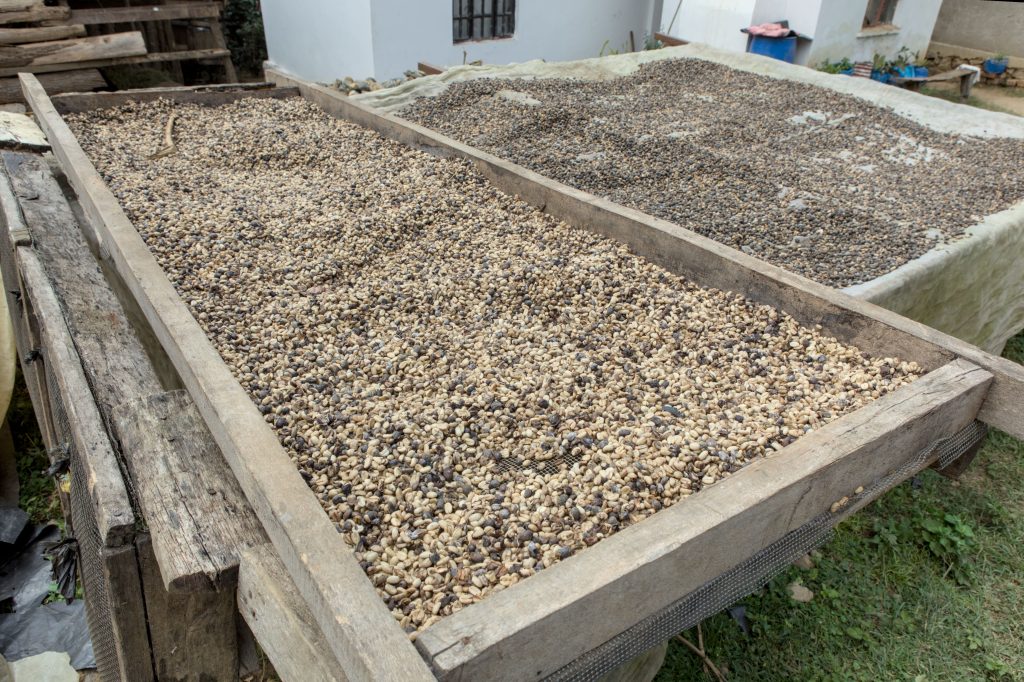
Tanzania’s green coffee grading splits into two tracks depending on processing method, and conflating them is a common buyer error coffeebean.tz’s grading piece identifies. Naturally processed (“hard”) arabica is sorted by screen size and density into eleven grades — AAA, AA, A, B, PB, C, E, F, AF, TT, UG, plus TEX — where AA means the largest beans, sorted on 17–18 mm screens, and peaberry (PB) is a naturally occurring single round bean rather than the usual paired halves, commanding real premiums in the US specialty market. Washed (“mild”) arabica, which accounts for roughly 90% of Tanzania’s arabica crop, uses a different and more granular system: parchment is split into P1/P2/P3 groups, then scored on a 17-point scale combining size, density, cup quality, defect count, and roasted appearance, with classes 1–3 indicating fine-to-good quality and classes 4–6 falling into “fair average quality” (FAQ). Only about 37% of national production met specialty-grade thresholds as of the 2020 baseline the article cites.
The core point, stated directly in the piece: an offer sheet listing “AA” or “PB” is describing bean size and density — a physical sorting system — not a cupping score. A buyer sourcing for flavor, not just for roast-uniformity, needs the washed-lot class number (1–17) and the quality basket (Grinders/FAQ/AMEX), not the letter grade alone, because the letter grade alone tells you almost nothing about whether the coffee in the bag will cup as advertised. (Full breakdown: coffeebean.tz, “Screen Size Isn’t Cup Quality”.)
Honey: a national compliance rate that hides batch-level failure
Honey’s quality axis is chemical, not visual: moisture content, diastase enzyme activity, and hydroxymethylfurfural (HMF). The EU Honey Directive and Codex Alimentarius cap moisture below 20%; Tanzania’s own 2007 Honey Quality Guidelines permit up to 21%, aligned to the EU’s 2001 directive. Diastase activity has to exceed 8 on the Schade scale as a freshness marker, and HMF — an indicator of heat exposure or age — has an EU ceiling of 40 mg/kg, though premium retail buyers often push suppliers toward readings closer to 10 mg/kg.
Here’s the buyer-relevant fact honey.tz’s reporting surfaces: a field study of 21 export-oriented Tanzanian honey samples found three exceeded the 21% moisture limit, one reaching 27.9% — well past any workable export threshold. The root cause traced in the piece is harvest timing, not the honey itself: bees signal that ripening is complete by capping the comb cells, and honey pulled before that capping retains more water. Most Tanzanian beekeepers, working without hydrometers or refractometers in the field, harvest on a fixed seasonal calendar rather than by observing capping — so moisture is effectively locked in weeks before any lab ever tests it. Tanzania’s often-cited 97% national compliance figure (largely a residue-testing statistic) is a real, sourced number — but it describes the aggregate, not the specific drum a buyer is about to receive. As the article puts it, a national compliance percentage is not a substitute for a certificate of analysis on the specific lot being purchased. (Full breakdown: honey.tz, “The Moisture Line”.)
Cloves: grade as a three-to-five-day weather bet
Zanzibar’s clove grading, run through the Zanzibar State Trading Corporation (ZSTC), is a four-tier price scale rather than an internationally codified standard like coffee’s or cashew’s: as of August 2023, Grade One commanded roughly 15,000 TZS/kg against 7,000 TZS/kg for the lowest grade — more than double, within one harvest season, for the same crop. The tiers are set by moisture content, color, and the proportion of broken or headless buds in a batch: premium hand-picked cloves need moisture below 10%, first grade below 11%, and lower grades are permitted up to 13% before mold risk and rejection kick in.
What determines almost all of that variance is not the tree, the season, or even the picking — it’s a three-to-five-day drying window on woven mats in the open air, with no mechanical dryers in general use. clove.tz’s reporting frames this bluntly: a batch caught by rain, dried unevenly, or pulled off the mat too early carries that damage all the way to the buying station, and the drying phase is worth more to a Pemba household’s final price than almost anything that happened on the tree. Grade here is less a measure of the clove’s intrinsic properties and more a record of whether the weather cooperated during a single week. (Full breakdown: clove.tz, “From Branch to Mat”.)
The pattern underneath all four
Lay these side by side and a buyer-relevant pattern emerges — this is our own synthesis, not a claim made by any single source above. In every one of these four commodities, the headline grade or letter code is a proxy for a physical sorting criterion (size, density, visual defect, or moisture), not a direct measure of the outcome the buyer actually cares about (taste, shelf stability, functional performance). And in every case, the gap between the proxy and the outcome is misunderstood in a specific, recurring way: coffee buyers assume AA tastes better than A; cashew buyers assume W320 is a freshness indicator; honey buyers assume a country-level compliance statistic covers the drum in front of them; clove buyers treat grade as fixed by the tree rather than by a single week’s drying conditions.
Crop-year variation compounds this. Rainfall timing shifts moisture at harvest for honey and cloves; a wet start to the cashew season affects outturn ratios before kernels are ever graded; a given year’s washed-coffee volumes shift the ratio of specialty-grade to FAQ lots. A grade earned in one season is not a guarantee repeated the next — which is precisely why a certificate of analysis tied to the specific lot, not a historical or national average, is the only real safeguard.
What this means in practice
None of this replaces the mechanics of pre-shipment verification — sampling protocols, third-party inspection firms, and the procedural checklist for confirming a shipment matches its contract are covered in depth in the site’s own Trade Guide: “Quality Inspection & Pre-Shipment Verification”. That guide answers “how do I verify a shipment.” This article answers a prior question: verify it against what? The practical implication of the four cases above is that a buyer’s contract specification needs to name the commodity-specific parameter that actually predicts the outcome they’re paying for — the washed-lot class number for coffee cup quality, the kernel class and moisture reading for cashew freshness, the per-drum moisture and HMF figures for honey, the per-batch moisture and broken-bud percentage for cloves — rather than a single grade label borrowed from a general sense of “premium.” A grade code, in every one of these markets, is a sorting result. Whether it is also the quality a buyer needs is a separate question that has to be asked explicitly, every time, for every commodity.
- cashews.tz — "What 'W320' Actually Means: A Plain-English Guide to Cashew Kernel Grades" — https://cashews.tz/what-w320-actually-means-a-plain-english-guide-to-cashew-kernel-grades/ — accessed 2026-09-27
- coffeebean.tz — "Screen Size Isn't Cup Quality: How Tanzania Actually Grades Green Coffee" — https://coffeebean.tz/screen-size-isnt-cup-quality-how-tanzania-actually-grades-green-coffee/ — accessed 2026-09-27
- honey.tz — "The Moisture Line: Why Tanzanian Honey Still Fails Export Standards at the Batch Level" — https://honey.tz/the-moisture-line-why-tanzanian-honey-still-fails-export-standards-at-the-batch-level/ — accessed 2026-09-27
- clove.tz — "From Branch to Mat: How Drying Decides a Zanzibar Clove's Grade" — https://clove.tz/from-branch-to-mat-how-drying-decides-a-zanzibar-cloves-grade/ — accessed 2026-09-27
- What “W320” Actually Means: A Plain-English Guide to Cashew Kernel Grades
- Screen Size Isn’t Cup Quality: How Tanzania Actually Grades Green Coffee
- The Moisture Line: Why Tanzanian Honey Still Fails Export Standards at the Batch Level
- From Branch to Mat: How Drying Decides a Zanzibar Clove’s Grade
- Quality Inspection & Pre-Shipment Verification