Cinnamon, Nutmeg and Pepper Grow in Zanzibar Too — They Just Never Became an Export Industry
Published 27 September 2026 · Commodities.tz Editorial
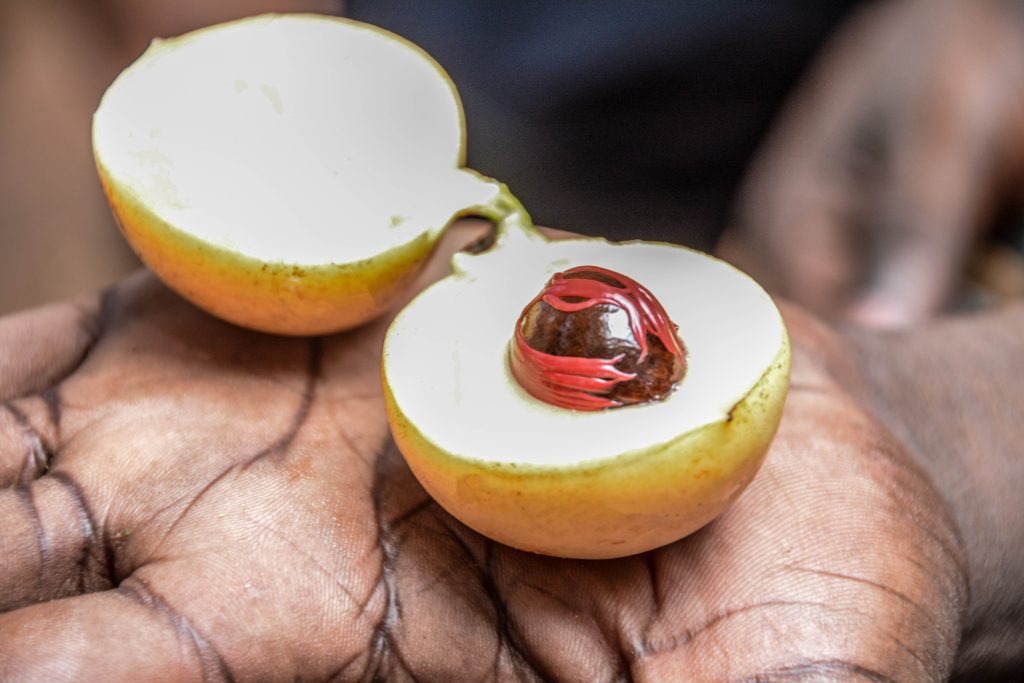
Zanzibar’s spice tours stop at the same six or seven plants every time: clove, of course, but also black pepper vines, cinnamon trees with their bark scraped bare, and nutmeg pods split open to show the red lace of mace inside. All three genuinely grow on the islands. None of them became an export industry the way cloves did.
The reason traces back to the same 19th-century push that built Zanzibar’s clove economy in the first place. When Sultan Said bin Sultan moved his capital to Zanzibar and began planting cloves at scale in the 1820s-30s, he also established a government spice garden at Kizimbani, outside Stone Town, to study and propagate other spices alongside it — cinnamon, pepper, ginger, nutmeg and cacao among them. Kizimbani still operates as a government-maintained plantation today, and it is now the centerpiece of the spice tours that bring tourists through Zanzibar’s countryside. What it never became was a second commodity export system. Cloves got the state marketing monopoly, the trading corporation, and eventually a place in Tanzania’s trade statistics. Cinnamon, pepper and nutmeg stayed in mixed smallholder gardens — a few trees or vines here and there, intercropped with coconut and clove — grown for the tourist trade, local kitchens, and the occasional specialty buyer, never for large-volume export.
That smallholder pattern is still how it works. Pemba Island cooperatives growing pepper describe it as a garden crop: peppercorns develop on vines climbing coconut and clove trees on sloped, sandy hillsides, picked by hand while still green or left a little longer to ripen orange, then sun-dried into the finished berry. It is the same labor-intensive, small-plot model that makes Zanzibar clove farming what it is — just without the government buyer standing at the other end. Where a clove farmer sells into the ZSTC system at a fixed producer price (see our companion piece on how that system works), a pepper or cinnamon grower more often sells informally, through a tour-farm shop, or into a one-off relationship with a specialty importer.
Trade data hints at how small that industry really is — and points the other direction from what the spice-tour narrative implies. The U.S. Department of Agriculture’s 2025 exporter guide to Zanzibar flags “spices (pepper & cardamom)” as the fastest-growing line in Zanzibar’s consumer-goods imports, up 250% since 2020 to $5.67 million in 2024 — driven by tourism and hospitality demand for packaged, branded spice products. Cardamom is not grown in Tanzania at all (see our Cardamom.tz coverage), so that import line is essentially restaurants and hotels buying in the finished spices their own guests expect to see growing outside. It is a useful reminder that “Spice Island” is a tourism brand built almost entirely on clove history and a handful of garden crops, not a diversified spice-export economy.
None of this means cinnamon, pepper and nutmeg are unimportant to Zanzibar — they are a real part of what smallholder farms grow, what spice tours sell, and what shows up in local cooking. It means a buyer looking for Tanzanian pepper or cinnamon at commodity volumes will not find a ZSTC-style channel to buy through, the way a clove buyer can. What exists instead is a small number of cooperative or single-farm relationships, typically built by a specialty importer over years of direct contact — not a listed export sector with public production or trade-volume data.
- Zanzibar Exporter Guide — USDA Foreign Agricultural Service, GAIN Report TZ2025-0006, prepared by Benjamin Mtaki (June 27, 2025) — https://apps.fas.usda.gov/newgainapi/api/Report/DownloadReportByFileName?fileName=Zanzibar+Exporter+Guide_Dar+Es+Salaam_Tanzania_TZ2025-0006.pdf
- Kizimbani — Wikipedia — https://en.wikipedia.org/wiki/Kizimbani
- Zanzibar Black Peppercorns — Burlap & Barrel (importer's own sourcing account) — https://www.burlapandbarrel.com/products/zanzibar-peppercorns